No products in the cart.

-28%

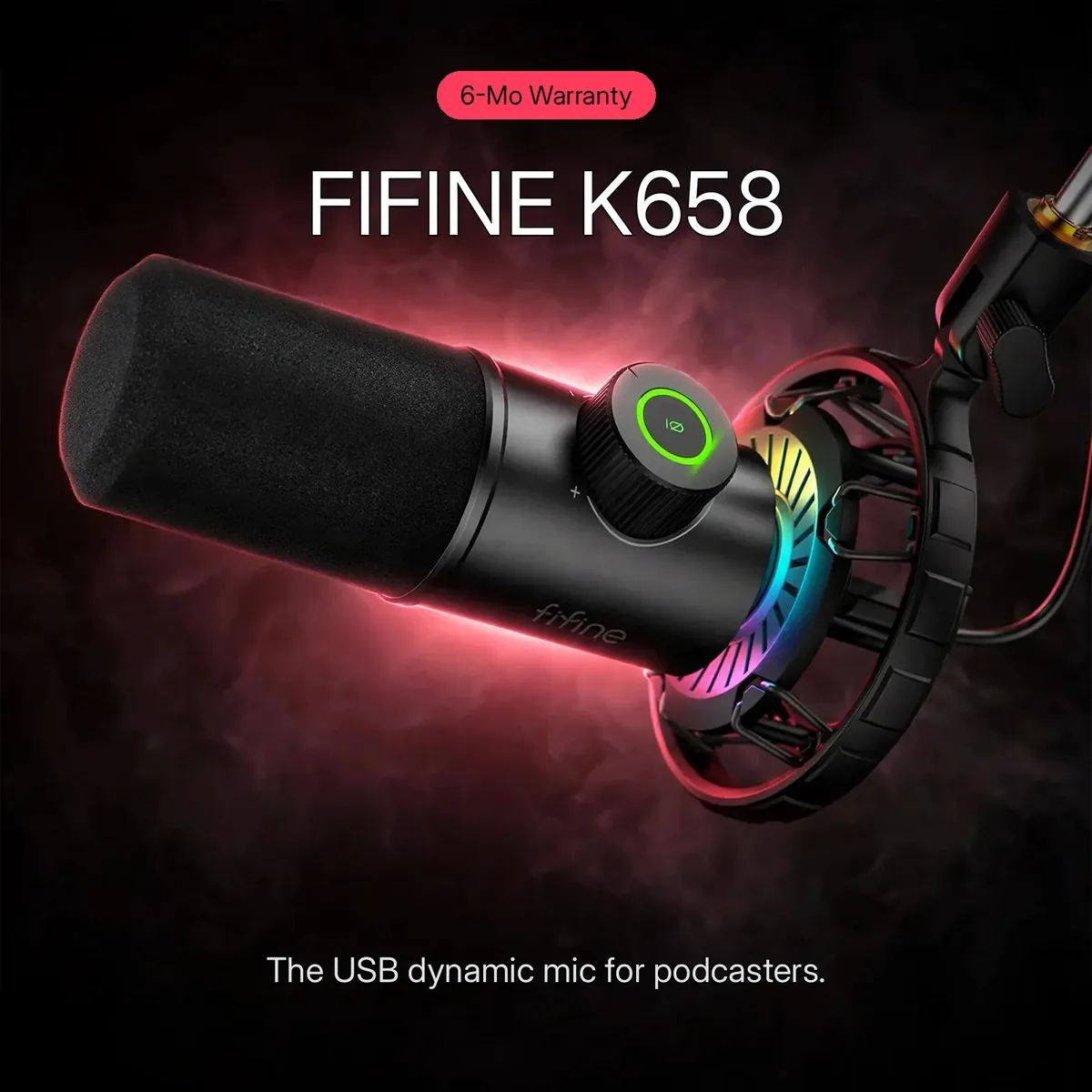
Podcast sound without the interface homework. The FIFINE K658 is the USB dynamic microphone for podcasters, streamers, and gamers who want broadcast-style voice with none of the audio-interface decisions — plug the included USB cable into a PC or PS5 and the fifine k658 is recording in seconds, with no drivers and no extra gear to research. One cable, one connection, zero decisions about mixers, preamps, or interfaces: the fifine k658 is the microphone for the buyer who just wants it to work.
Two honest framings before the details. First, this is the USB-only K658 — not the K688 (which adds an XLR path) and not the AM8 (the USB/XLR gaming microphone), and not a condenser like the A6T. The USB-only design is the entire point: nothing to upgrade into, nothing to research, nothing to get wrong. Second, everything below comes from the verified research notes for this exact model — 16-bit/48kHz audio, 70Hz–15kHz response, tap-to-mute with LED status, a smooth gain dial, breathing RGB, and latency-free 3.5mm monitoring. Nothing is guessed, and nothing is borrowed from FIFINE’s other microphones.
At its heart is a dynamic cardioid capsule — the architecture that keeps your voice front and center while pushing keyboard clatter, fan hum, and room echo aside. Condenser microphones pick up everything in an untreated room; its dynamic capsule focuses on what is directly in front of it and rejects the rest, which is exactly what a bedroom studio, a shared flat, or a noisy gaming corner needs. Position it close, speak naturally, and the fifine k658 does the rest.
Dynamic Cardioid for Real Rooms
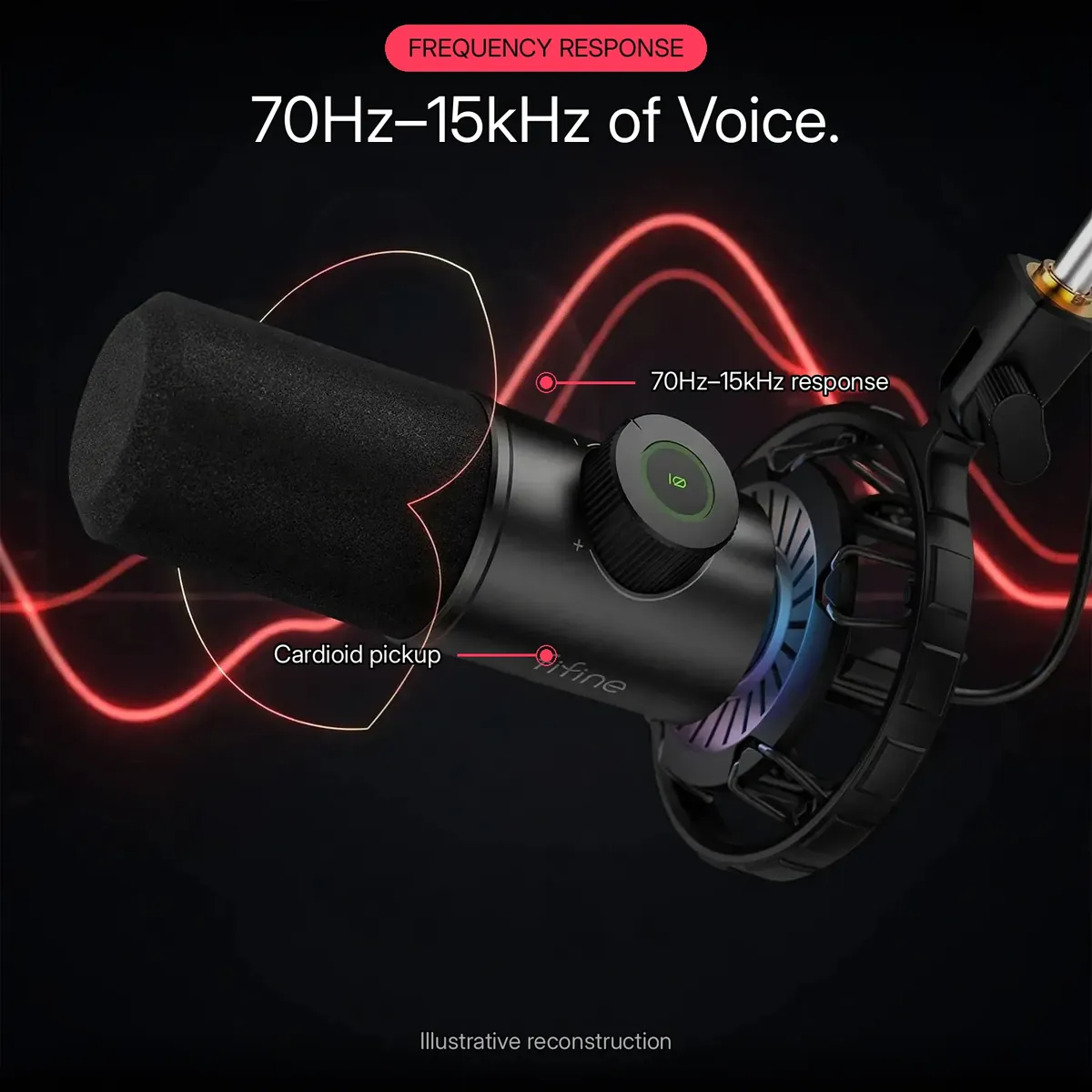
The cardioid pickup graphic above is this mic’s whole philosophy in one image: voice in, room out. The cardioid pattern captures sound from the front — your voice — while rejecting off-axis noise from the sides and rear, so keyboard clatter, mouse clicks, and the fan across the room never make it into the recording. With a 70Hz–15kHz frequency response covering deep lows and crisp highs, -50 ± 3dB sensitivity at 1kHz, ≥-70dBA signal-to-noise, and 110dB maximum SPL, it handles everything from whispered asides to excited shoutcasts without falling apart. And because it is dynamic, it never needs phantom power — this mic draws everything it needs from the USB connection.
Silence in a Tap
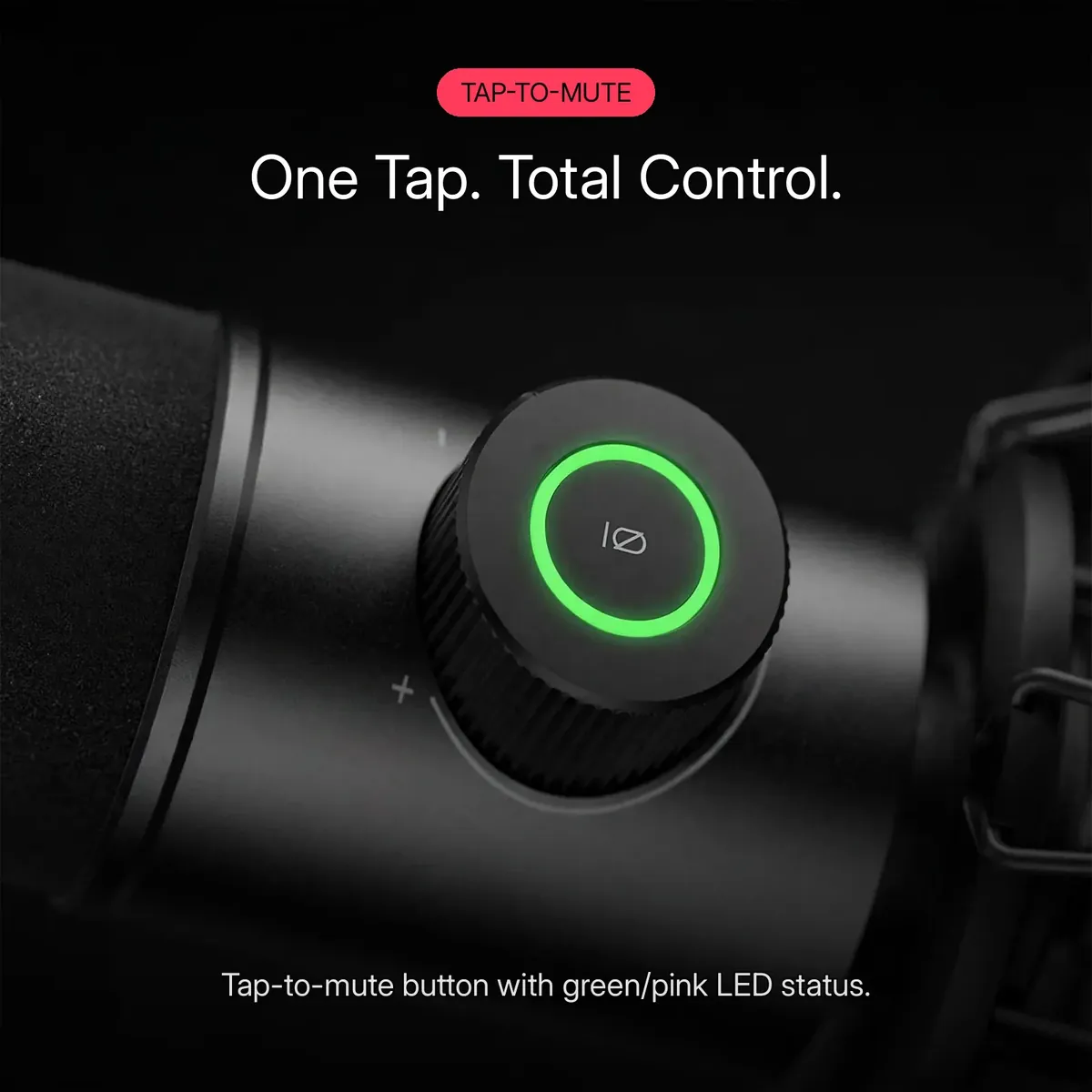
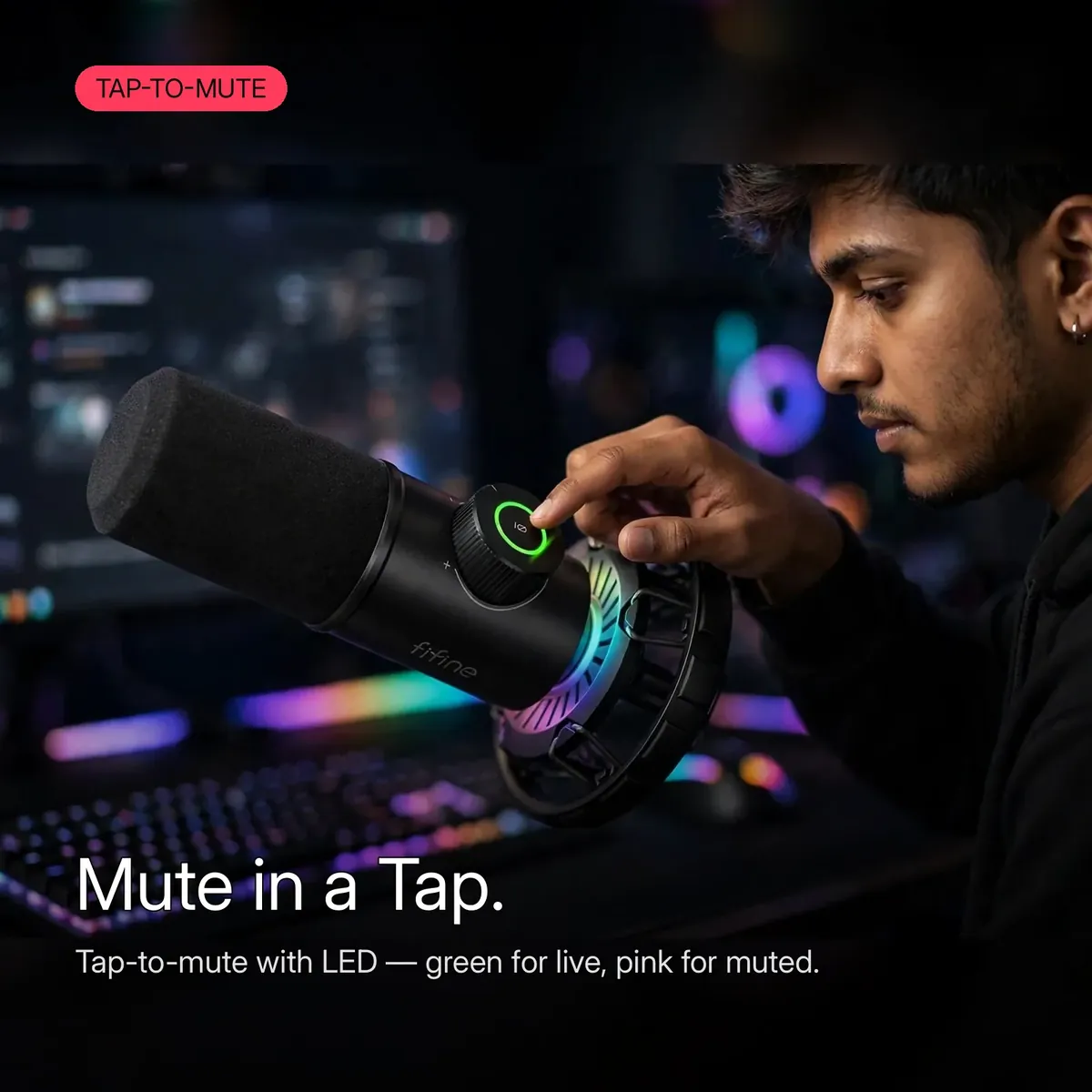
Every podcaster knows the moment: the cough, the doorbell, the family member who walked in mid-sentence. The fifine k658 answers with a tap-to-mute button on top of the microphone — one tap and you are silent, another tap and you are live. The LED ring tells the whole story at a glance: green means live, pink means muted, so you never have to guess whether the mic is hot. Mute anxiety — the fear of being live when you should not be — is solved with a fingertip.
Dial In Your Level
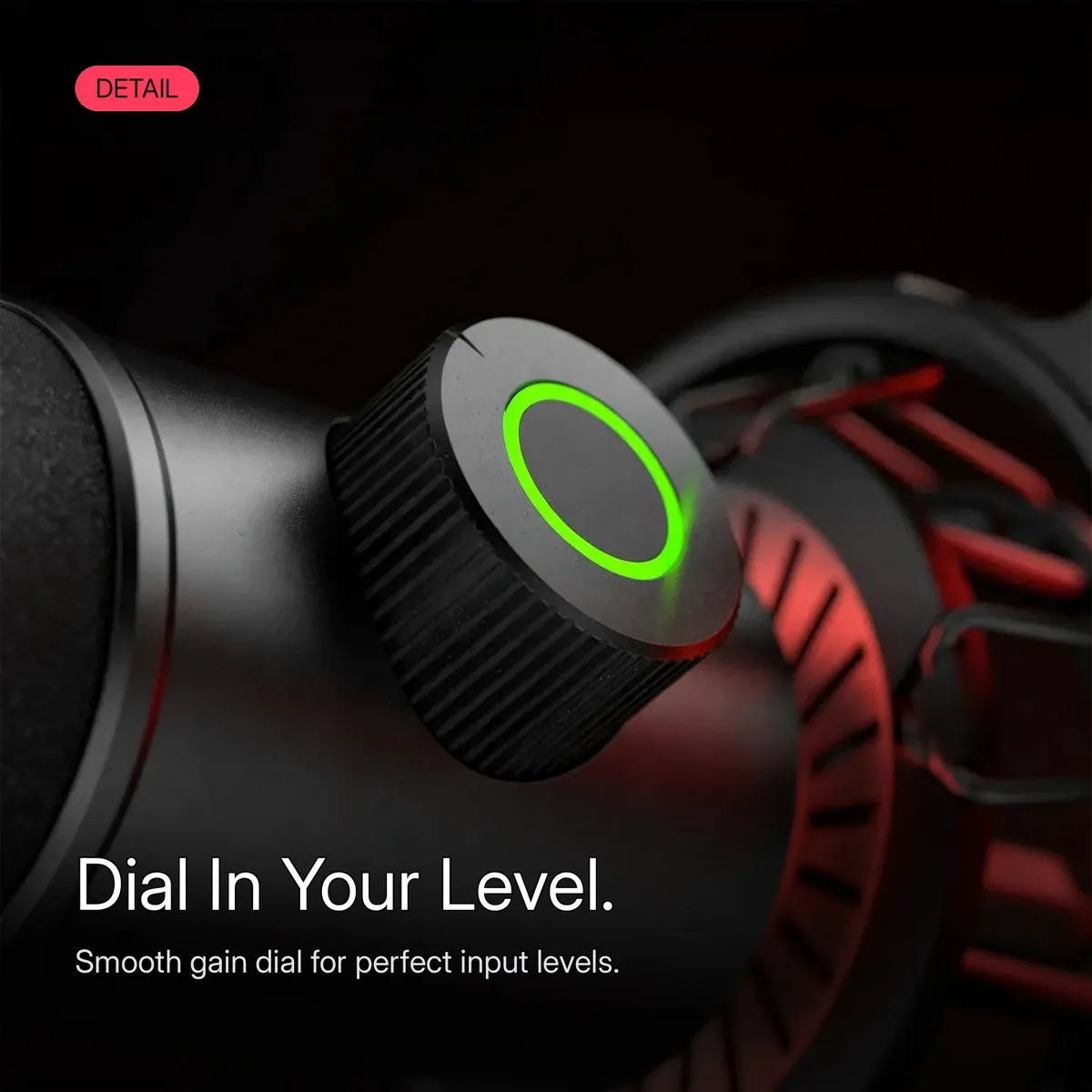
The same top control doubles as a smooth gain dial — tap it to mute, turn it to set your input level. Set the fifine k658 once for your voice and your room, and you never touch software sliders mid-recording again. The LED ring around the dial glows green while you are live and flips pink when muted, so your level control and your status indicator are the same glanceable control. Simple, physical, instant: the fifine k658 keeps your sound in your hands, not in a menu.
Hear Yourself, Live
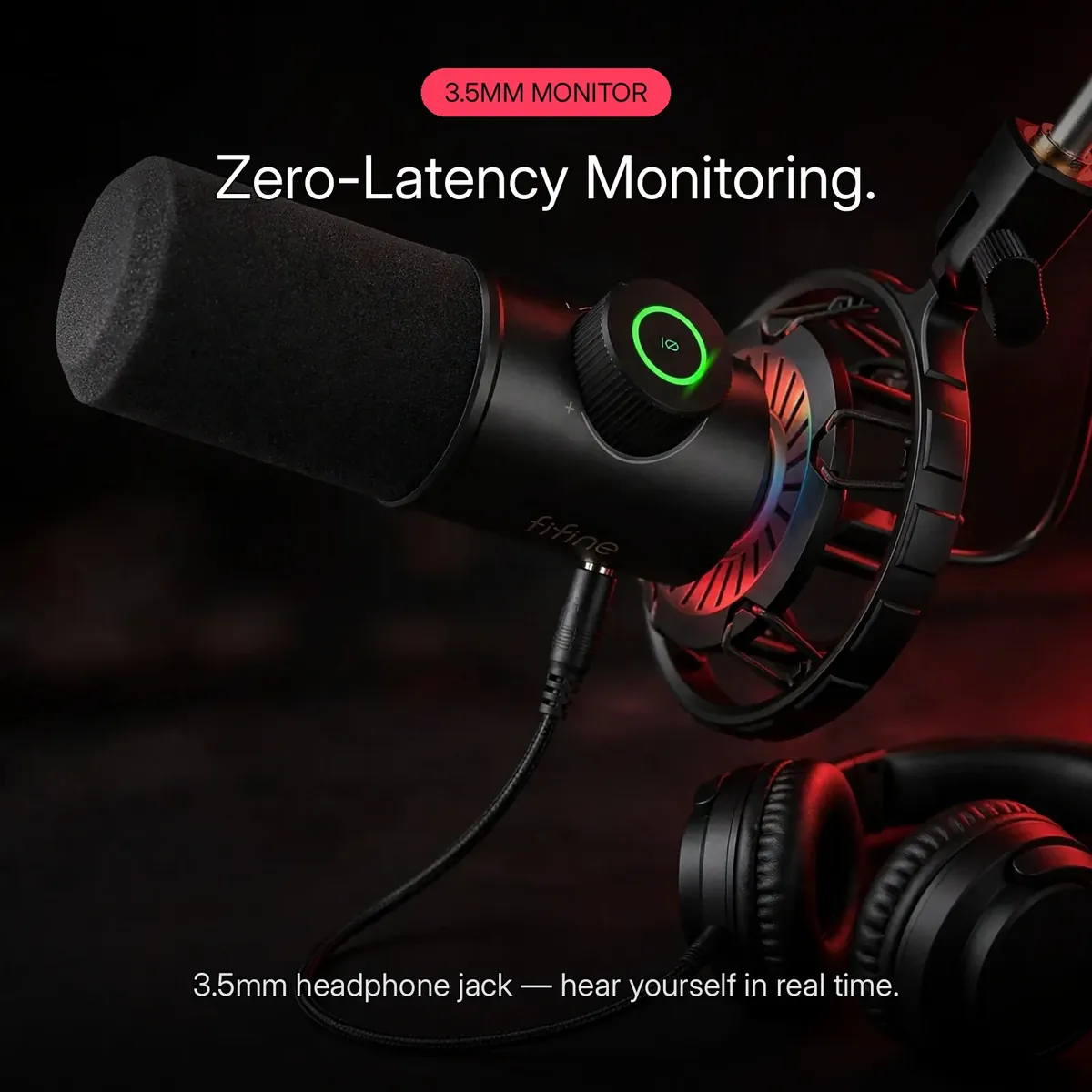
The 3.5mm headphone jack on the fifine k658 gives you real-time, latency-free monitoring — you hear exactly what the microphone captures, with no delay and no echo. Set your gain with confidence instead of guessing, catch plosives and mic-technique issues as they happen, and record every take knowing it is hearing what you are hearing. Latency anxiety disappears when the monitoring path is hardware: plug headphones in and your voice comes back live.
Breathing RGB on Your Terms
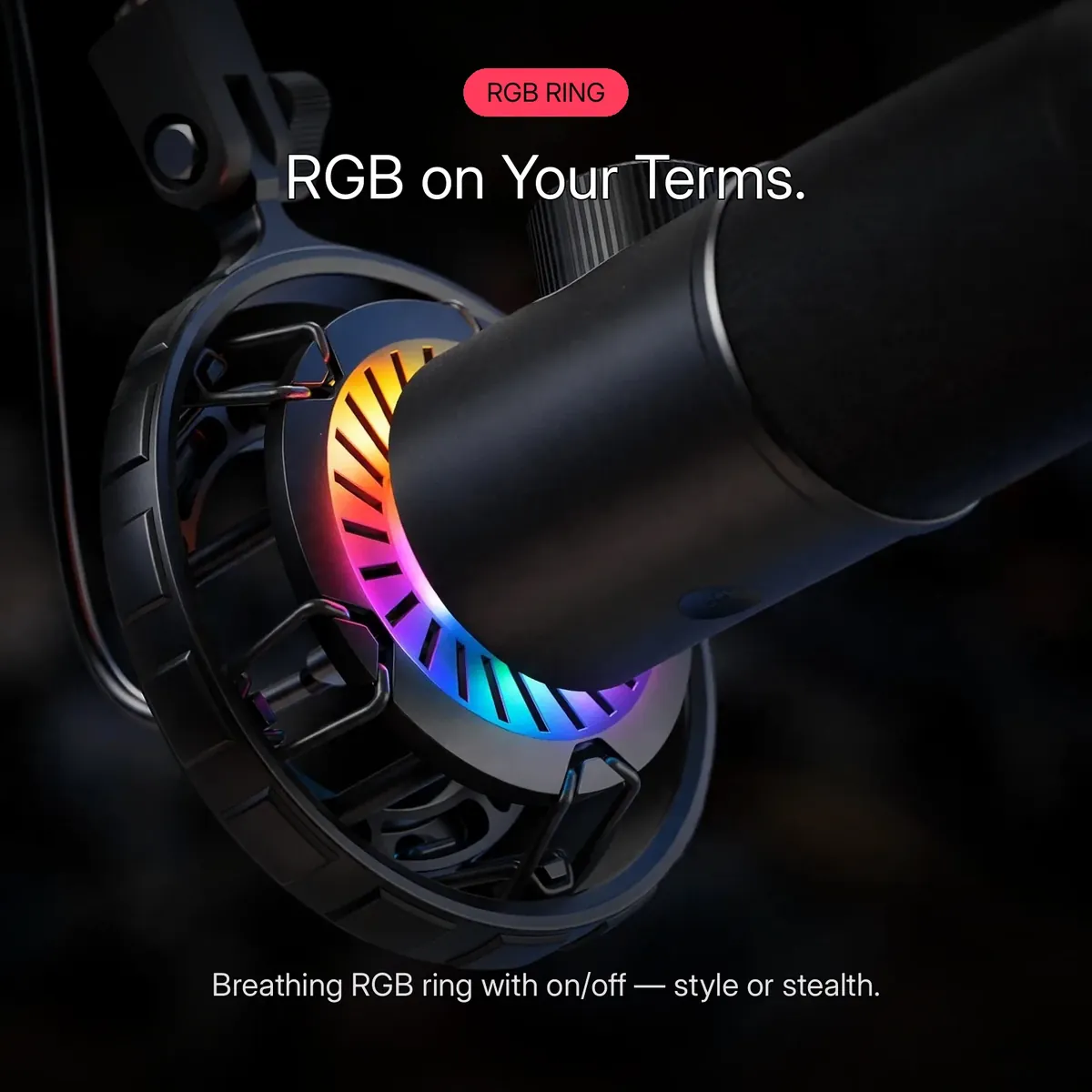
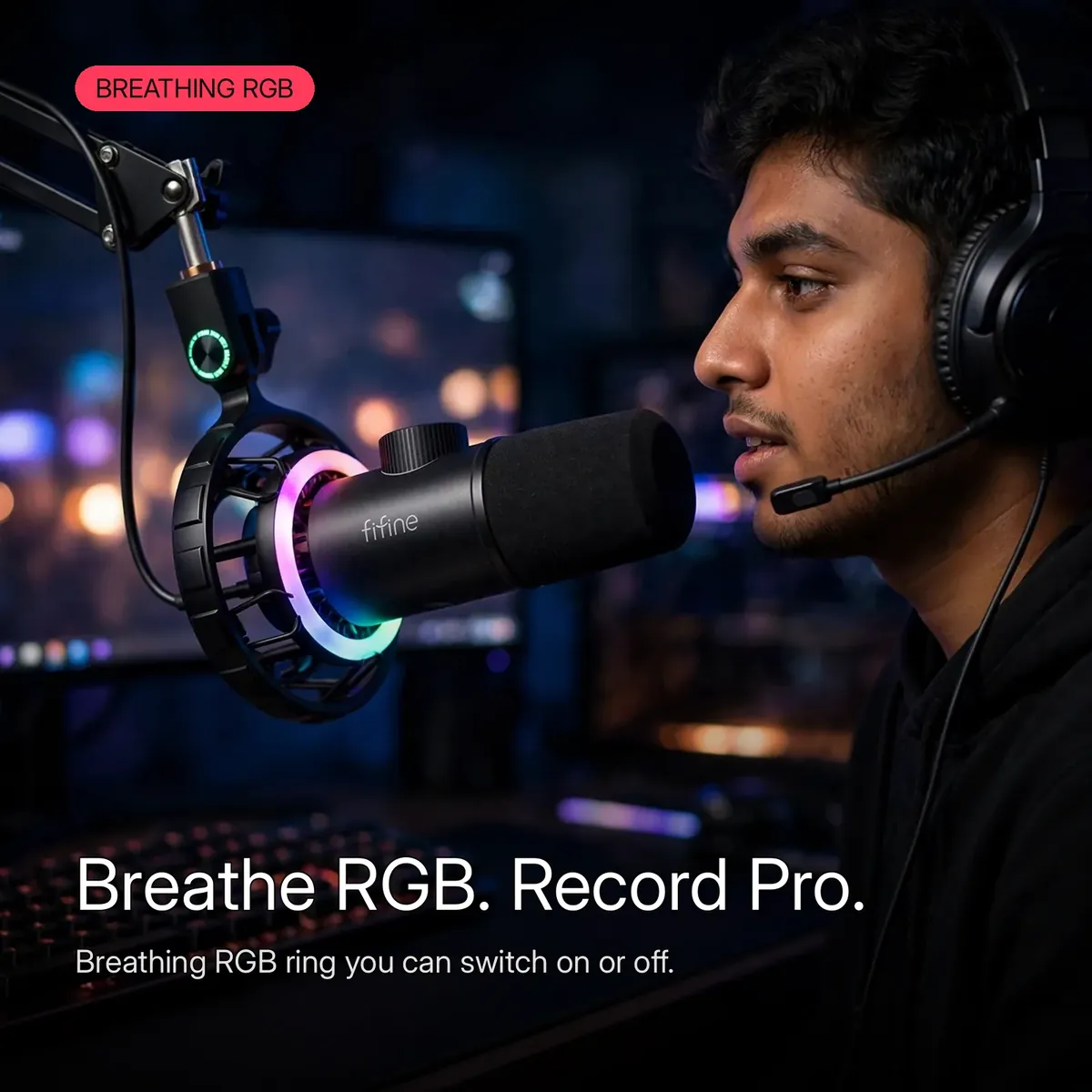
The breathing RGB ring at the base of the fifine k658’s shock mount adds gaming-desk character that pulses gently while you record — and switches off completely when you want a clean, professional look. On for the stream, off for the client call: it never forces an aesthetic on you. The RGB is pure atmosphere — it never touches the audio, and it sounds exactly as good with the lights off.
Every Control, Illuminated
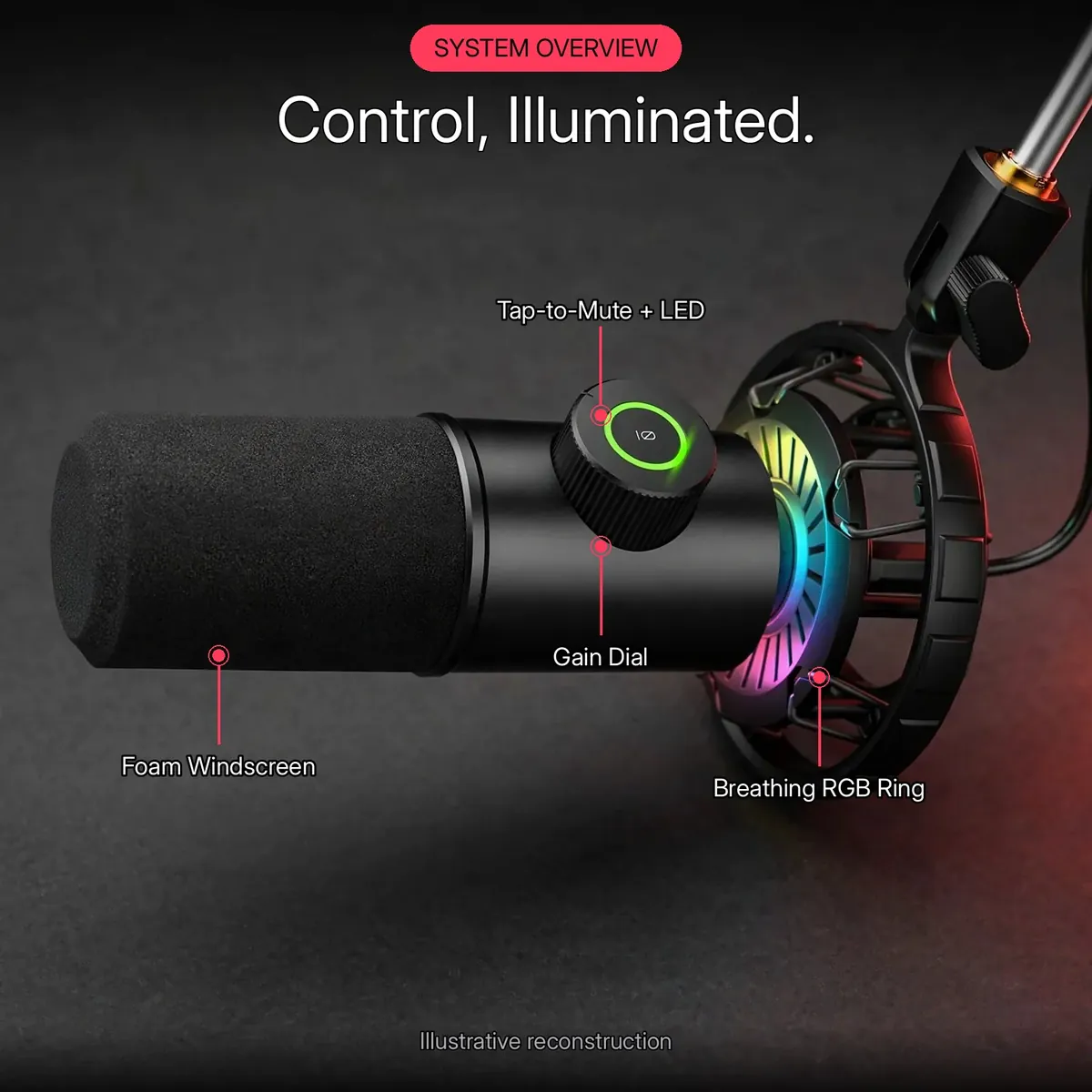
Tap-to-mute with LED, gain dial, foam windscreen, breathing RGB ring — this microphone keeps everything on the hardware itself, and the layout diagram above maps it at a glance. There is no software to install, no control panel to learn, no setting buried three menus deep: every adjustment the fifine k658 offers lives on the mic. The diagram is an illustrative reconstruction of the verified K658 control layout, not a circuit schematic — the controls themselves are exactly where the image shows them.
Inside the FIFINE K658
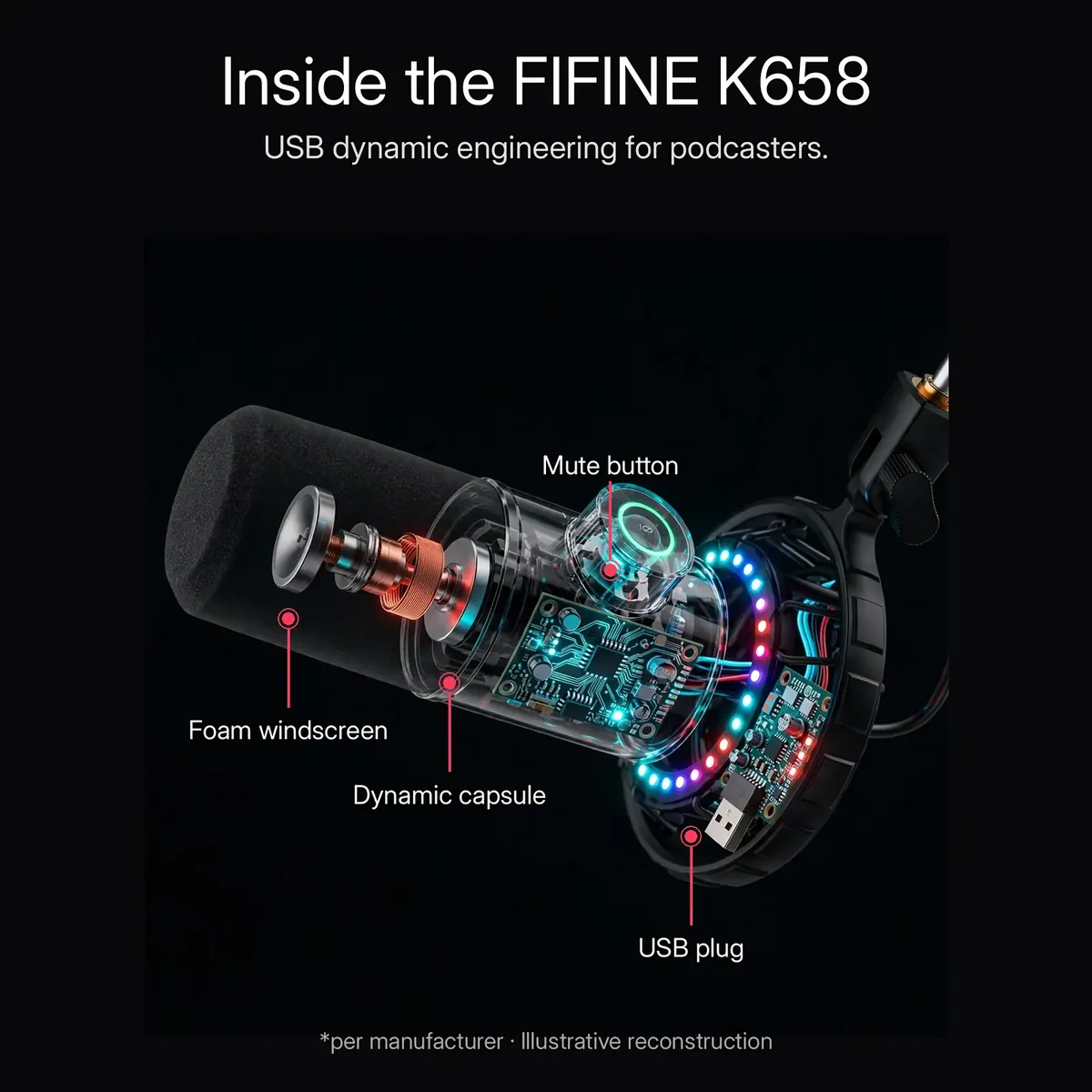
Under the shell, it is built around a glowing dynamic capsule feeding a dedicated USB audio circuit — one capsule, one clean digital path, no compromise. The all-metal body shields the electronics and survives daily desk life, while the customized shock mount isolates the capsule from desk bumps and keyboard vibration. The x-ray render above is an illustrative reconstruction of the manufacturer’s listed internals — the dynamic capsule, mute button, foam windscreen, and USB plug — not a photograph of disassembled hardware.
What’s in the Box
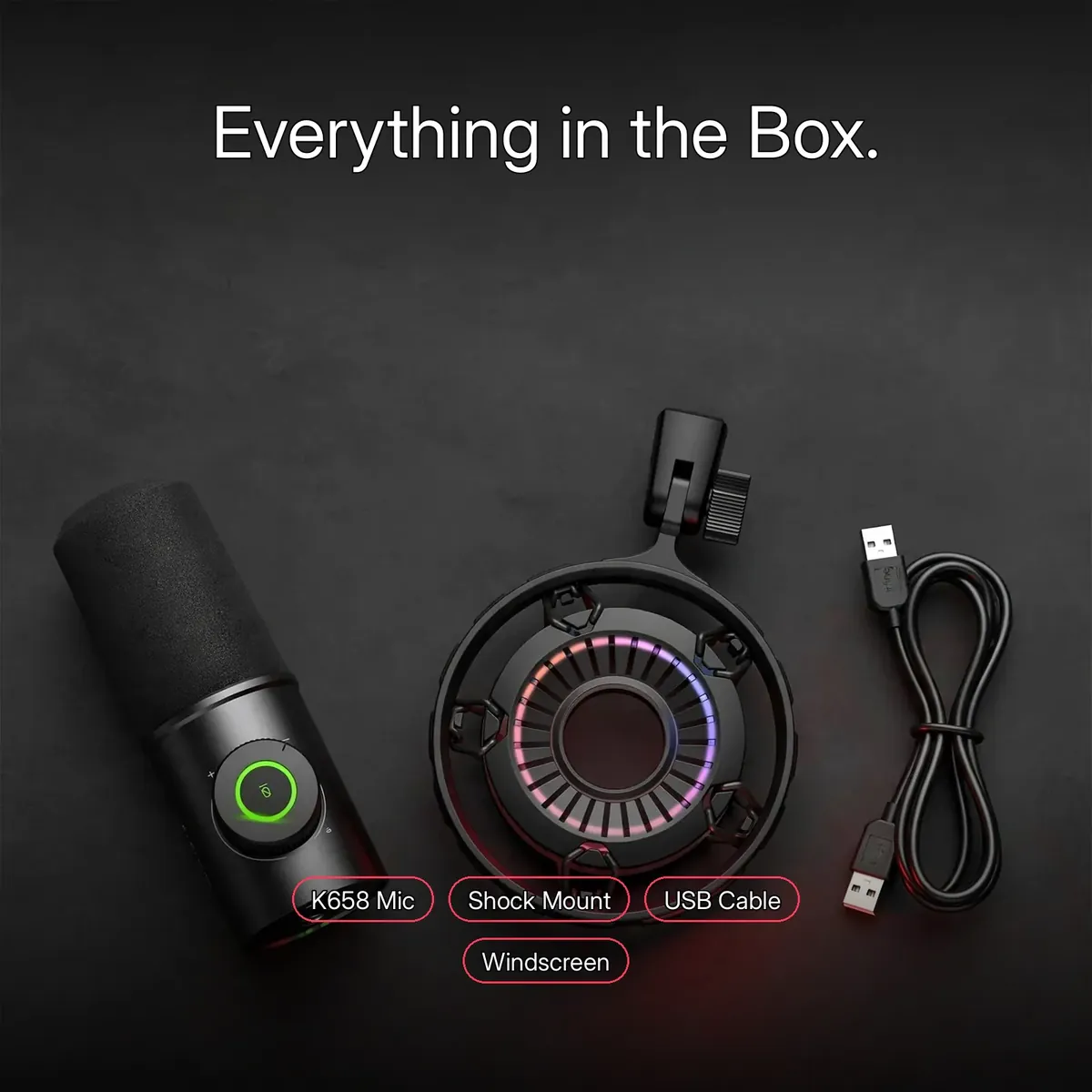
The box contains the K658 microphone, the customized shock mount, the USB cable (USB Type-C at the microphone end, Type-A 2.0 at the computer end), and the foam windscreen that doubles as the external pop filter — everything the flat-lay above shows, and nothing it does not. The internal pop filter is already built into the microphone, so plosive protection is covered twice: inside the capsule chamber and at the foam windscreen. The kit is ready for USB recording out of the box on PC, PS4/PS5, and DAW software — no interface, no phantom power, no extras to buy.
Specifications
| Brand | FIFINE |
|---|---|
| Model | K658 (USB Dynamic Cardioid Podcast Microphone) |
| Acoustic principle | Dynamic (no phantom power needed) |
| Polar pattern | Cardioid |
| Frequency response | 70Hz – 15kHz |
| Sensitivity | -50 ± 3dB (at 1kHz) |
| Signal-to-noise ratio | ≥-70dBA |
| Max SPL | 110dB |
| Bit depth / sample rate | 16-bit / 48kHz |
| Output | USB Type-C (mic) to Type-A 2.0 (computer) |
| Controls | Tap-to-mute button doubling as gain/volume dial; green/pink LED status (green = live, pink = muted) |
| RGB lighting | Breathing RGB ring, switchable on/off |
| Monitoring | 3.5mm headphone jack, latency-free |
| Compatibility | PC, PS4/PS5, DAW and recording software |
| Build | All-metal body, customized shock mount |
| Pop filters | Internal + external (foam windscreen) |
| Box contents | K658 microphone, customized shock mount, USB cable, foam windscreen |
| Warranty | a 7-day store warranty |
All figures are taken from the verified research notes and the live store product page. Do not confuse this microphone with the K688 (XLR/USB), the A6T condenser, or the AM8 (USB/XLR gaming microphone).
What the Numbers Mean: 70Hz–15kHz, 110dB SPL and 16-Bit/48kHz
Three figures in the specifications table carry the whole sound story of the fifine k658, and each translates cleanly into listening terms. The 70Hz–15kHz frequency response spans the full working range of the human voice: 70Hz at the bottom is deep enough to keep a low voice sounding full rather than thin, and 15kHz at the top is where the consonants live — the s, t and f sounds that decide whether speech sounds crisp or muffled. Nothing a podcaster says falls outside what this microphone is built to capture.
The sensitivity and headroom figures work as a pair. Sensitivity of -50 ± 3dB at 1kHz means the capsule turns a normal speaking voice into a healthy recording level without strain, while the ≥-70dBA signal-to-noise ratio keeps the microphone’s own noise floor far below your voice. At the loud end, the 110dB maximum SPL is the ceiling before distortion: laughter, an excited shoutcast moment, or a guest who suddenly leans in and laughs will not crack the recording. Quiet stays quiet and loud stays clean — that is the combination the numbers are promising.
The 16-bit/48kHz recording format is the quiet professional choice. 48kHz is the sample rate video production runs on, so audio from the microphone drops onto a video editing timeline at the same rate as the footage, with no conversion step and nothing to drift out of sync over a long episode. It is the same pairing used across the verified spec table — nothing exotic, nothing proprietary, just the standard format of recorded speech, delivered over one USB cable. It also means the microphone asks for no format decisions from you: plug it into the recording software you already use, and every take is already at the rate your timeline expects.
One Microphone, Three Kinds of Recording Day
Podcast mornings are the fifine k658’s home ground. Sit close to the capsule, set the gain dial once for your voice and your room, plug headphones into the 3.5mm jack, and the session runs itself: you hear every take exactly as it is captured, the tap-to-mute swallows the cough or the doorbell, and the dynamic capsule keeps the untreated room out of the recording. The routine takes minutes to learn because every control is on the microphone itself.
Game nights change the costume, not the microphone. The breathing RGB ring comes on for the stream, the same USB plug-and-play connection works straight into a PS5, and the tap-to-mute doubles as your team-chat privacy switch between matches. The all-metal body and customized shock mount shrug off the desk bumps of an animated session, and the foam windscreen plus the internal pop filter keep excited commentary clean.
Then there is the third day: the work call, the client recording, the serious voiceover. Switch the RGB off and the fifine k658 becomes a clean, professional desk microphone with no gaming costume in sight. Same capsule, same controls, same one-cable setup — the microphone adapts to the day by changing its lighting, not its sound.
Why Buy From Gadget Superb
Order the fifine k658 from Gadget Superb with cash on delivery anywhere in Bangladesh — pay in cash when the parcel arrives, with no drivers and no extra gear to research. Delivery takes 1–3 working days inside Dhaka (৳70) and 2–5 working days outside Dhaka (৳120). Every order carries 7-day easy returns: keep the microphone in original condition with box and accessories, and start a return with your order number via hotline 09638054751, care@gadgetsuperb.com, or Messenger.
FIFINE is a global microphone brand — see fifinemicrophone.com — and Gadget Superb curates its models for Bangladeshi creators. Explore the full Audio Electronics collection or compare Microphones to find the right fit.
Frequently Asked Questions
Is this FIFINE K658 an original FIFINE product?
This listing is for this model as catalogued by Gadget Superb under the FIFINE brand. The store does not claim official-distributor status for any brand it carries. If authenticity documentation matters to you, message the store on Messenger or email care@gadgetsuperb.com before ordering and they will clarify what they can share.
Is the fifine k658 a USB or an XLR microphone?
It is USB-only — the cable runs USB Type-C at the microphone end to Type-A 2.0 at the computer, and there is no XLR connector. That is the K658’s whole proposition: no interface, no mixer, no phantom power, just plug-and-play recording. If you need XLR, look at FIFINE’s K688 or AM8 instead — this listing is the USB-only K658.
How is the K658 different from the K688 and the AM8?
The K658 is the USB-only podcast microphone: one cable, one connection, zero decisions. The K688 adds an XLR path alongside USB for mixers and interfaces, and the AM8 is the USB/XLR gaming microphone with a different control layout. Everything on this page describes the K658 — buy this listing only if the USB-only K658 is the microphone you want.
What are the verified key specs of the fifine k658?
It is a dynamic microphone with a cardioid polar pattern, 70Hz–15kHz frequency response, -50 ± 3dB sensitivity at 1kHz, ≥-70dBA signal-to-noise, and 110dB maximum SPL. It records at 16-bit/48kHz over USB Type-C to Type-A 2.0, with a tap-to-mute button, gain/volume dial, green/pink LED status, a breathing RGB ring with on/off, and latency-free 3.5mm monitoring. The body is all-metal with a customized shock mount, and it works plug-and-play with PC, PS4/PS5, and DAW recording software.
How does the tap-to-mute button work?
Tap the button on top of the fifine k658 and the microphone mutes instantly; tap again to go live. The LED ring tells your status at a glance — green means you are live, pink means you are muted. It is the fastest privacy switch a podcaster can ask for: cough, doorbell, off-mic conversation, gone in a tap.
How do the gain dial and live monitoring work?
The top control doubles as a smooth gain/volume dial — tap it to mute, turn it to set your input level without touching software sliders. The 3.5mm headphone jack gives you real-time, latency-free monitoring, so you hear exactly what the fifine k658 captures with no delay. Set your gain once, monitor live, and record with confidence.
Does the fifine k658 work with PS5?
Yes. It is plug-and-play on PC and PS4/PS5 as well as DAW and recording software — connect the included USB cable and it appears as a USB microphone. No drivers are needed, and no audio interface is ever required.
Will it pick up my keyboard noise and room echo?
Far less than a condenser would. Its dynamic cardioid capsule focuses on your voice in front of the microphone and rejects off-axis sound from the sides and rear, which is why it suits untreated rooms. Position it close to your mouth and keyboard clatter, fan hum, and room echo stay in the background where they belong.
Can I switch the RGB lighting off?
Yes. The breathing RGB ring at the base of the shock mount pulses gently while you record and switches off completely for a clean, professional look — for example on work calls. The lighting never affects its audio performance either way.
Does the fifine k658 come with a warranty?
This listing carries a 7-day store warranty, as listed on the product page. If a warranty matters to you, confirm the terms with the store — hotline 09638054751, care@gadgetsuperb.com, or Messenger — before placing your order.
How long does delivery take, and what are the charges?
Inside Dhaka, delivery costs ৳70 and takes 1–3 working days; outside Dhaka, it costs ৳120 and takes 2–5 working days. These are estimates, not guarantees. Your order ships once you place a cash-on-delivery order.
How does cash on delivery work? Can I check the microphone before paying?
Cash on delivery means you pay the courier in cash when the parcel arrives. Gadget Superb never asks for advance payment, card details, OTPs, or mobile-banking PINs. Couriers generally do not allow opening a parcel before payment, so check your microphone right after the courier leaves and contact the store within the 7-day return window if anything is wrong.
Does the fifine k658 need batteries or phantom power?
Neither. The fifine k658 is a dynamic microphone, and dynamic capsules never need phantom power; the microphone’s electronics draw everything they need from the USB connection to your PC or PS4/PS5. There is no battery to charge and no power supply to buy — if the USB cable is plugged in, the microphone is powered and ready.
What headphones can I use with the monitoring jack?
Any headphones with a standard 3.5mm plug. The monitoring jack is a plain 3.5mm headphone output, and it feeds you the microphone’s own signal in real time with no latency — so the earbuds or headphones already on your desk are all you need to hear exactly what is being recorded.
How close should I sit to the fifine k658 for the best sound?
Close. A dynamic cardioid capsule is designed to be worked at short range: speak toward the front of the microphone from a short distance and your voice dominates, while keyboard clatter, fan hum and room echo fall away at the sides and rear. The foam windscreen and the internal pop filter handle the plosives that close placement can exaggerate, so you get the presence of close miking without the pops.
If you are new to working a microphone this way, use the monitoring jack while you experiment: a few test lines at different distances will teach you more in a minute than any diagram, and the gain dial lets you balance what you hear on the spot until the distance feels natural.
Related products
-26%
49 in stock

SX23 Noise Canceling Mini Wireless Lavalier Microphone
Original price was: ৳ 2,950.৳ 2,180Current price is: ৳ 2,180.-28%
30 in stock

BOYALINK 3 AI-Powered Button Sized Wireless Microphone
Original price was: ৳ 15,230.৳ 10,950Current price is: ৳ 10,950.-27%
70 in stock
Ulanzi J12 Dual Wireless Microphone for Android With Charging Case For Type-C
Original price was: ৳ 4,110.৳ 3,000Current price is: ৳ 3,000.-23%
50 in stock


Hoco L21 ENC Wireless Microphone For Android
Original price was: ৳ 1,300.৳ 1,000Current price is: ৳ 1,000.-28%
30 in stock

MAONO PD300X USB/XLR Dynamic Microphone
Original price was: ৳ 13,200.৳ 9,490Current price is: ৳ 9,490. FIFINE K658 USB Dynamic Cardio...
Original price was: ৳ 8,510.৳ 6,120Current price is: ৳ 6,120.
54 in stock
Reviews
There are no reviews yet.