No products in the cart.

-21%
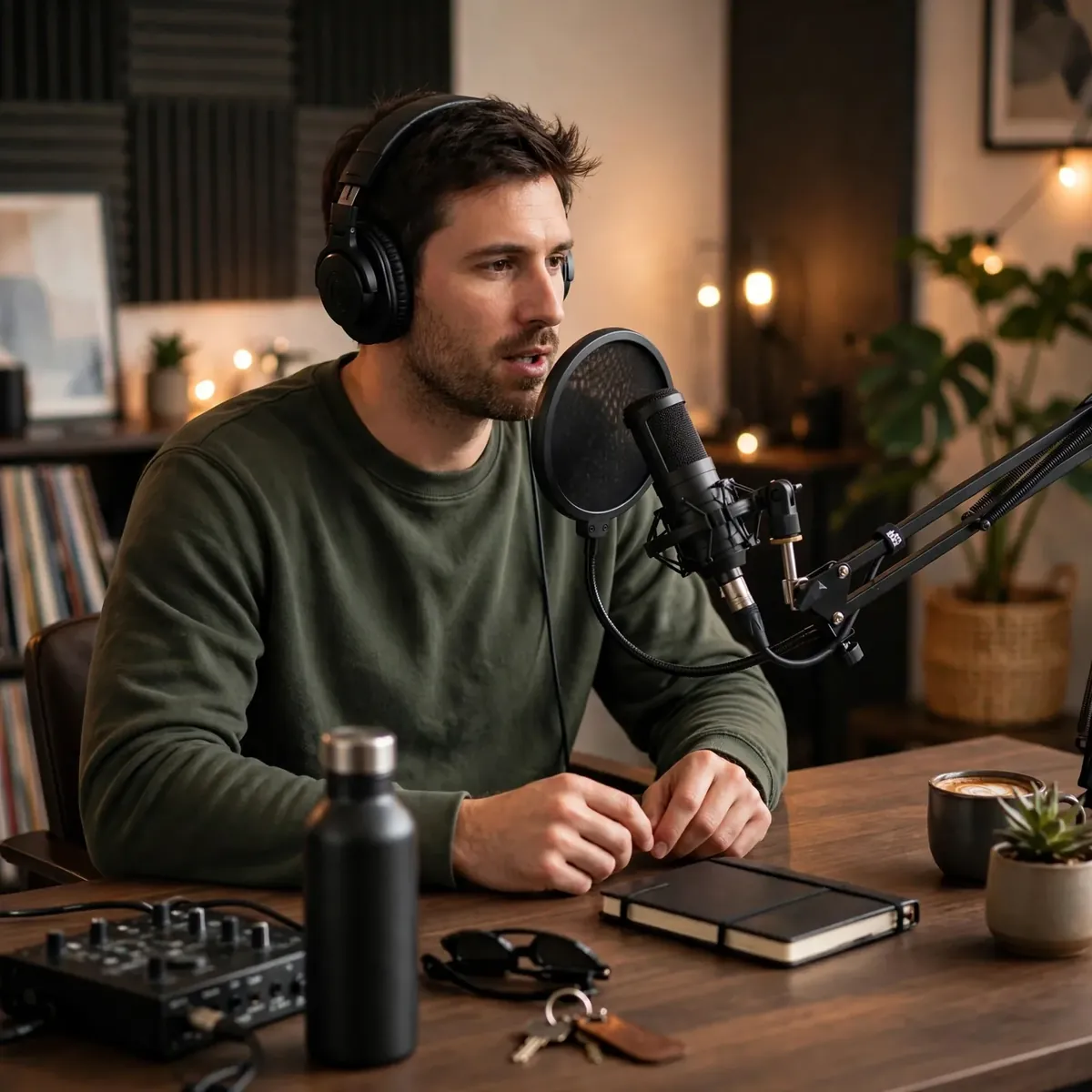
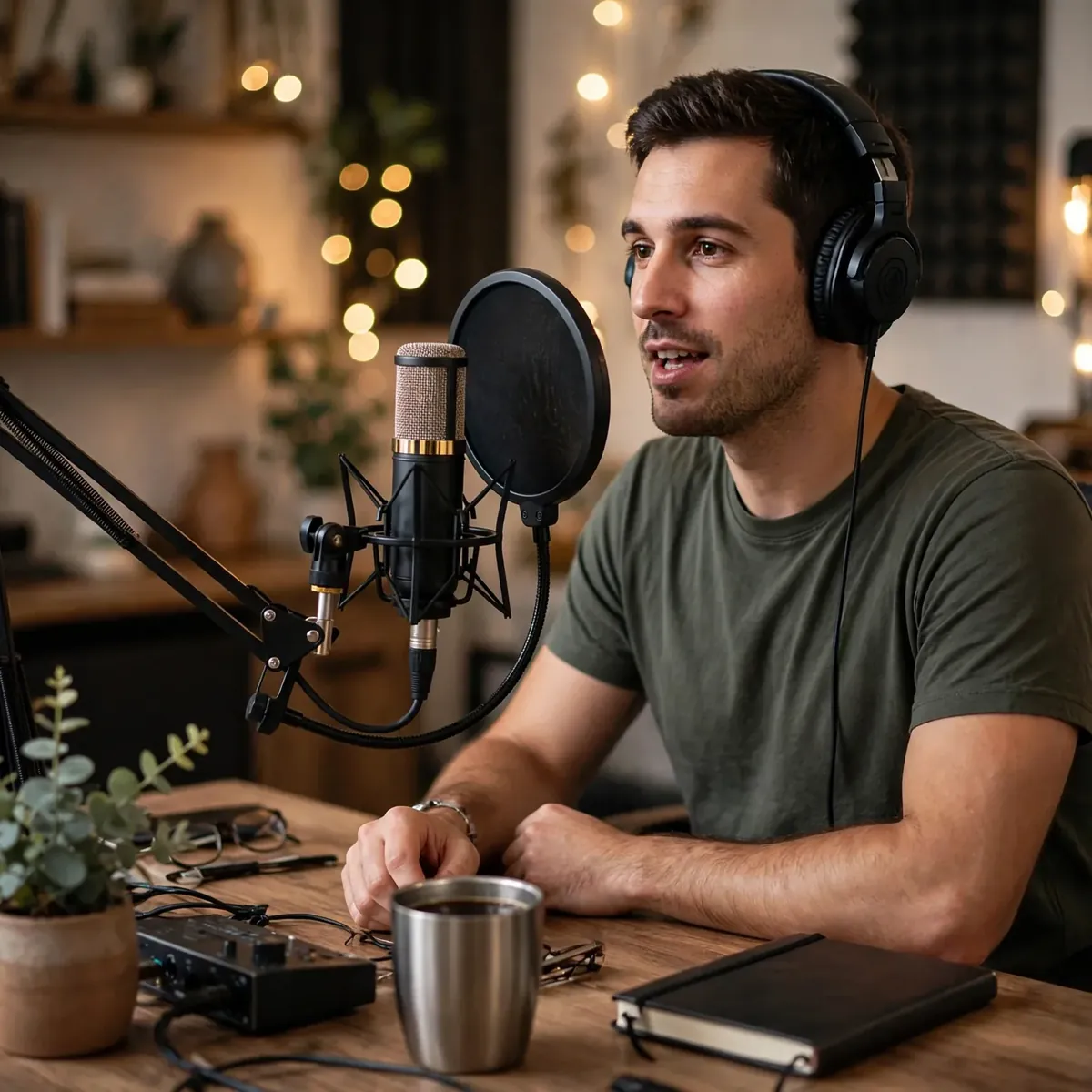


The cheapest studio-sounding upgrade a creator can buy. The wind pop filter is a dual-layer mesh screen on a 37.5cm flexible gooseneck arm that sits between your mouth and the mic — breaking up the blast of air behind plosives so your voiceovers, podcasts, and streams come out smooth and clear instead of distorted. If your recordings pop every time you say a P or B, you do not need a new microphone — you need this.
Honest framing first: the wind pop filter is an accessory, not a microphone — it upgrades the mic you already own. What the notes verify: the dual-layer mesh tames harsh P/B/T/K pops, hissing, and lisping while your voice passes through naturally; the screen catches spit and moisture from enthusiastic takes; the 37.5cm gooseneck bends to any angle and holds position; the adjustable screw clamp grips any mic stand up to 3.5cm thick. This page claims exactly what the verified notes carry — nothing more.
The rest of this page walks through the plosive problem, the gooseneck, the clamp, the parts, the coverage, the dual-layer build, and the full specs in detail. Every figure below — 15.5cm screen, 37.5cm arm, 3.5cm clamp, 278g — is taken from the verified research notes for the wind pop filter, and nothing here is invented. One brand note: no brand is assigned to this product — it is sold simply as the wind pop filter, and this page never invents one.
Kills Harsh P’s & B’s
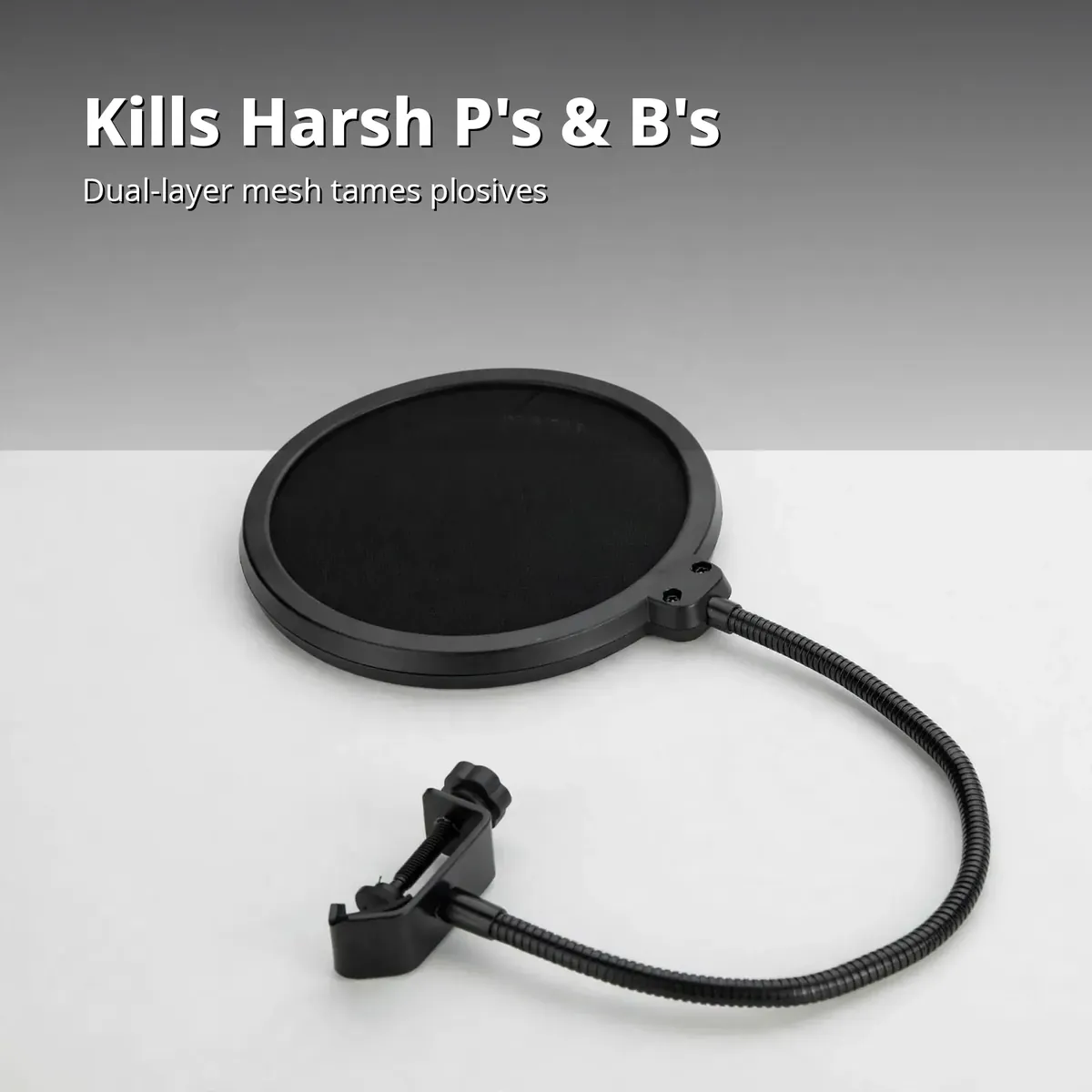
The card above states the whole job: “KILLS HARSH P’S & B’S,” with the subline “Dual-layer mesh tames plosives.” The wind pop filter’s two mesh layers break up the air blast behind plosives — the P, B, T, K bursts that clip and distort — plus hissing and lisping, while your voice passes through naturally.
The key honesty: it kills plosives, not your tone. Cheap foam covers muffle the voice; the dual-layer screen here is engineered to stop air, not sound. Your voice keeps its natural character — the pops just stop arriving.
Bends Any Way You Need
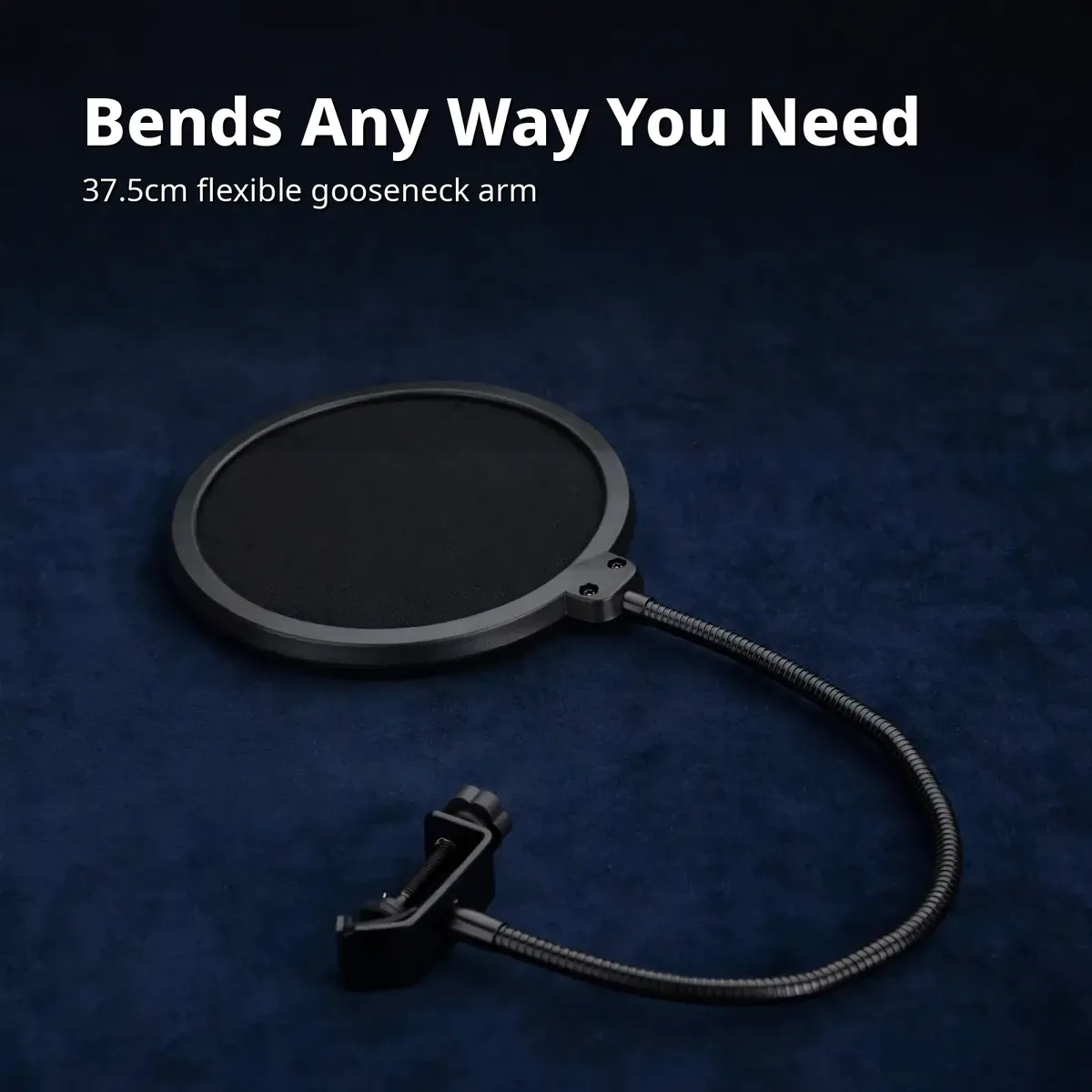
The card above is the positioning story: “BENDS ANY WAY YOU NEED,” with the subline “37.5cm flexible gooseneck arm.” The wind pop filter’s 37.5cm arm bends to any angle and holds its position through long sessions — swing the screen exactly between your mouth and the mic, then leave it there.
Position is everything with a pop filter: too far and the pops sneak past, too close and you are eating the mesh. The long flexible arm puts the 15.5cm screen exactly where your voice needs it, and it stays put while you move naturally.
Clamps to Any Stand
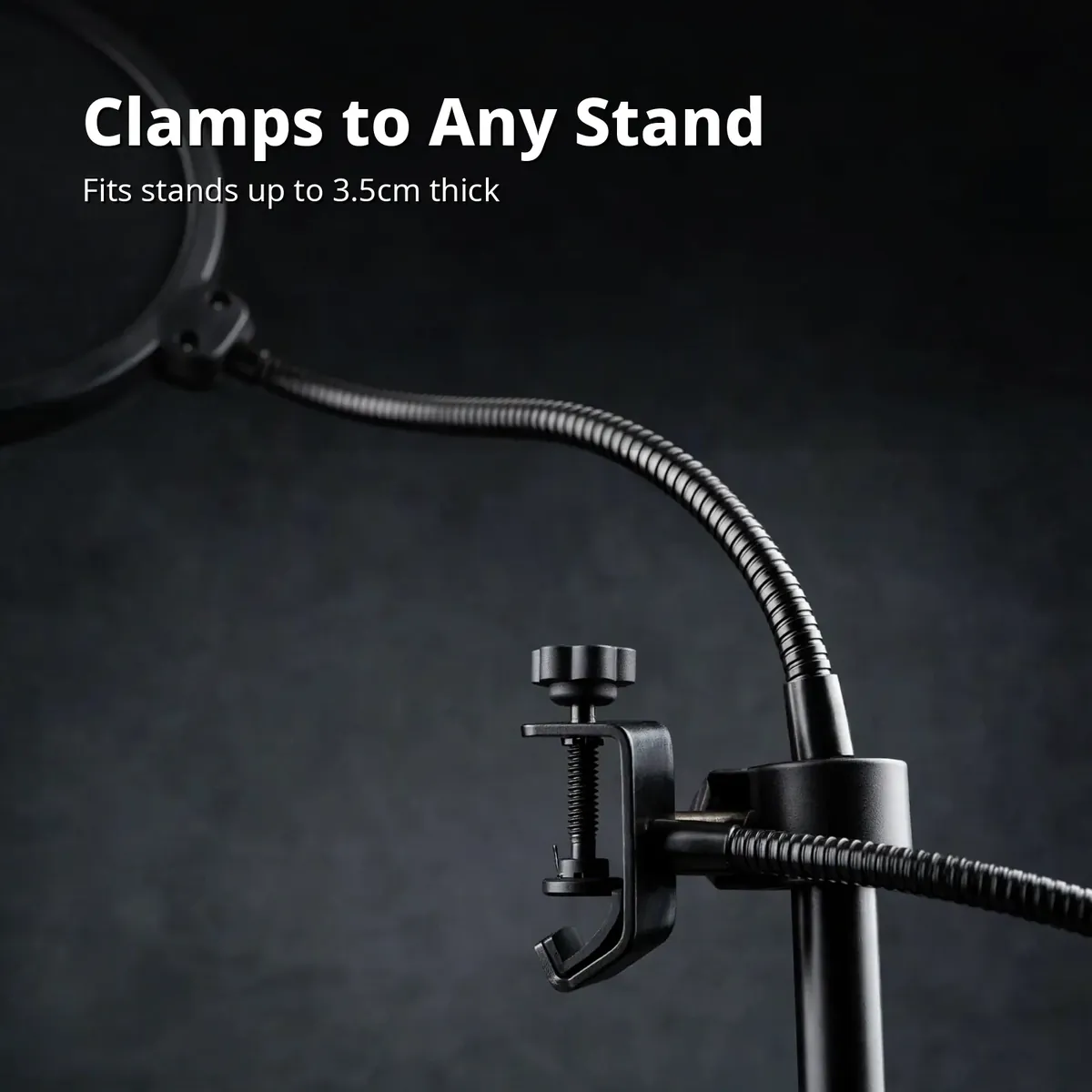
The card above states the fit promise: “CLAMPS TO ANY STAND,” with the subline “Fits stands up to 3.5cm thick.” The wind pop filter’s adjustable screw clamp grips desk arms, tripods, and floor stands alike — it is a universal accessory, not a brand-locked one.
This is the purchase-confidence detail: it works with studio condensers, USB mics like Blue Yeti, Boya, Rode and similar, desk mics, and stand mics. If your mic sits on a stand up to 3.5cm thick, this clamps on.
Built for Clean Takes
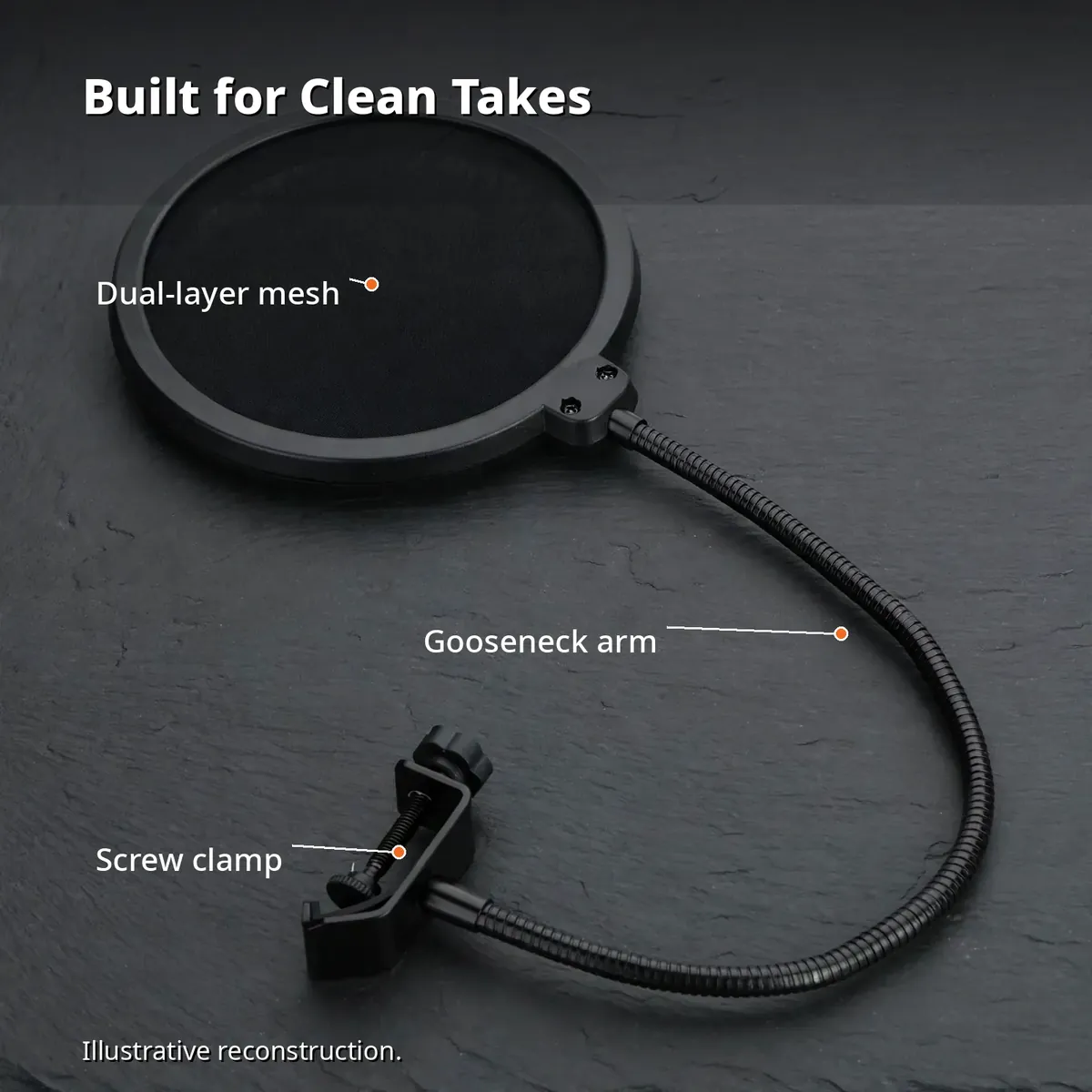
The infographic above maps the wind pop filter’s three parts with leader-line callouts: the dual-layer mesh, the gooseneck arm, and the screw clamp. Three callouts, three verified parts — footnoted as an illustrative reconstruction.
Simple products earn trust through honesty: this is mesh, arm, and clamp — 278g of black plastic and screen. No electronics, no batteries, nothing to charge. The infographic shows exactly what you are buying.
15.5cm of Coverage
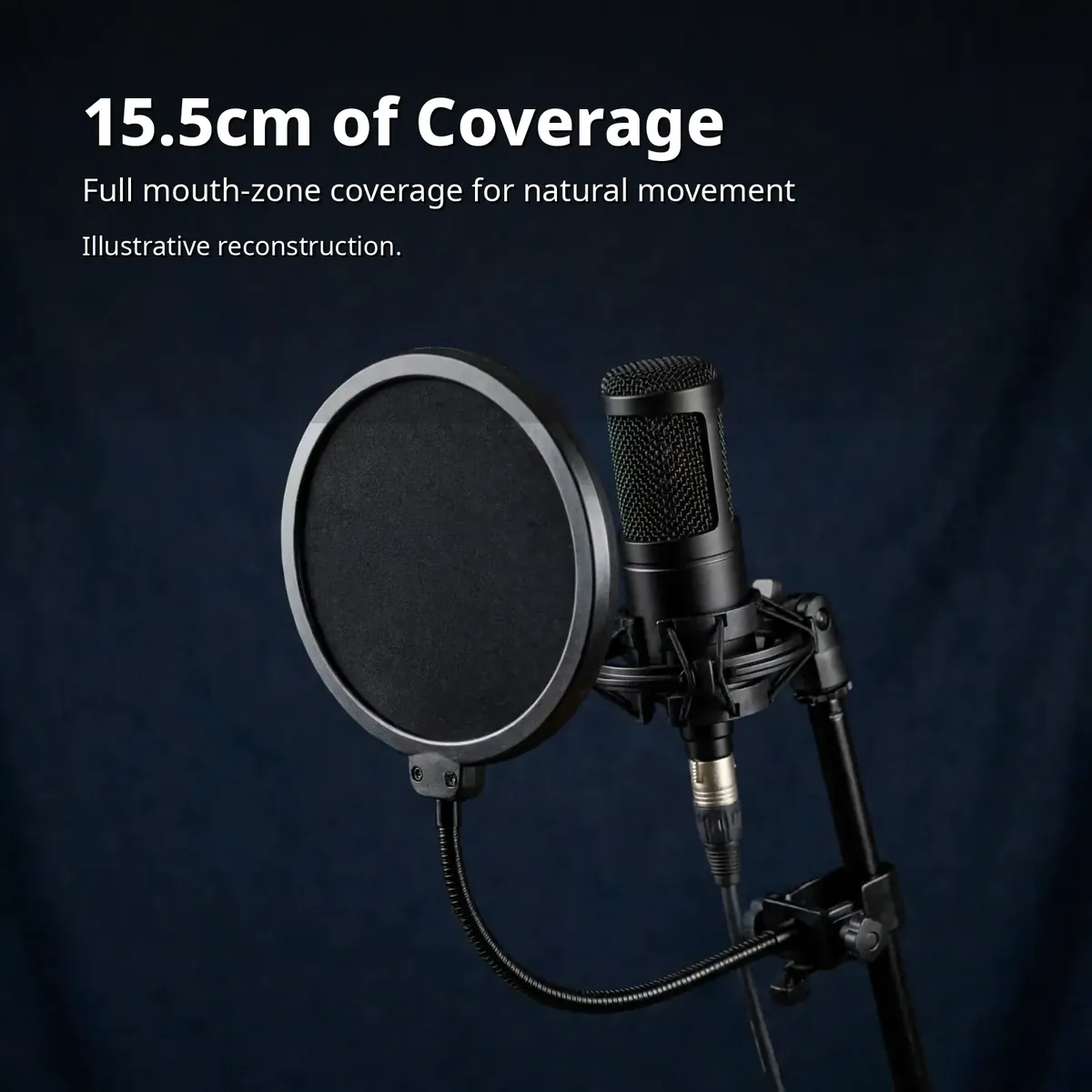
The infographic above is the sizing story: “15.5CM OF COVERAGE,” with the subline “Full mouth-zone coverage for natural movement.” The wind pop filter’s 15.5cm external screen (13.5cm internal) covers your whole mouth zone, so you can move naturally while you talk or sing without the pops finding a gap.
Coverage matters because creators move: podcasters lean in, singers sway, streamers gesture. The generous screen means the protection follows your voice, not the other way around.
Inside the Filter
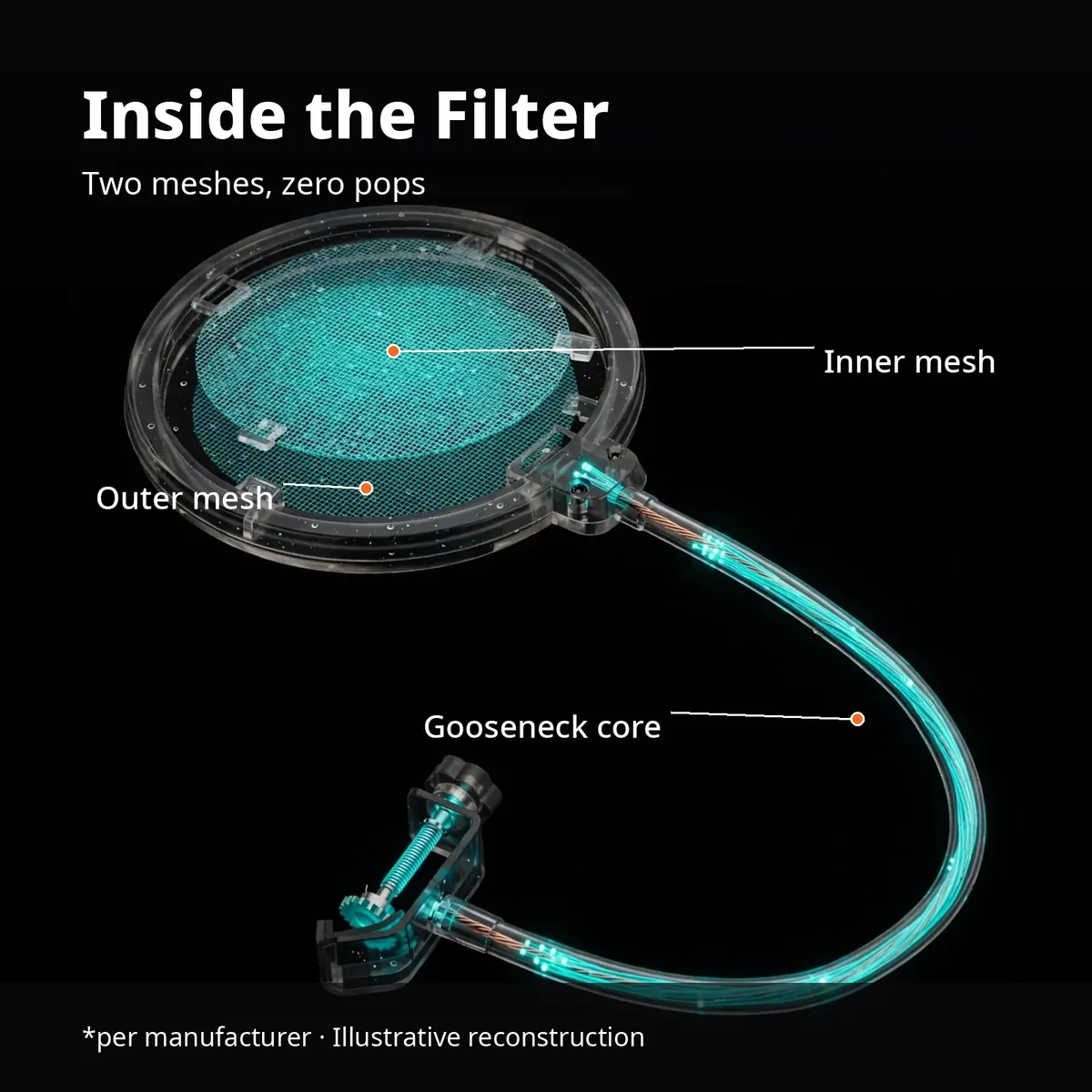
The x-ray above is an illustrative reconstruction — not a teardown photo — of the wind pop filter’s build: two glowing mesh layers with the gooseneck core behind them. Headline “Inside the Filter,” subhead “Two meshes, zero pops,” with leader-line callouts for the outer mesh, inner mesh, and gooseneck core — footnoted “*per manufacturer · Illustrative reconstruction.”
The two-layer trick: the outer mesh breaks the blast, the inner mesh catches what is left. One layer softens, two layers finish. The copy says the same as the image: a visualization of the build, not disassembled hardware.
Sound Studio-Clean
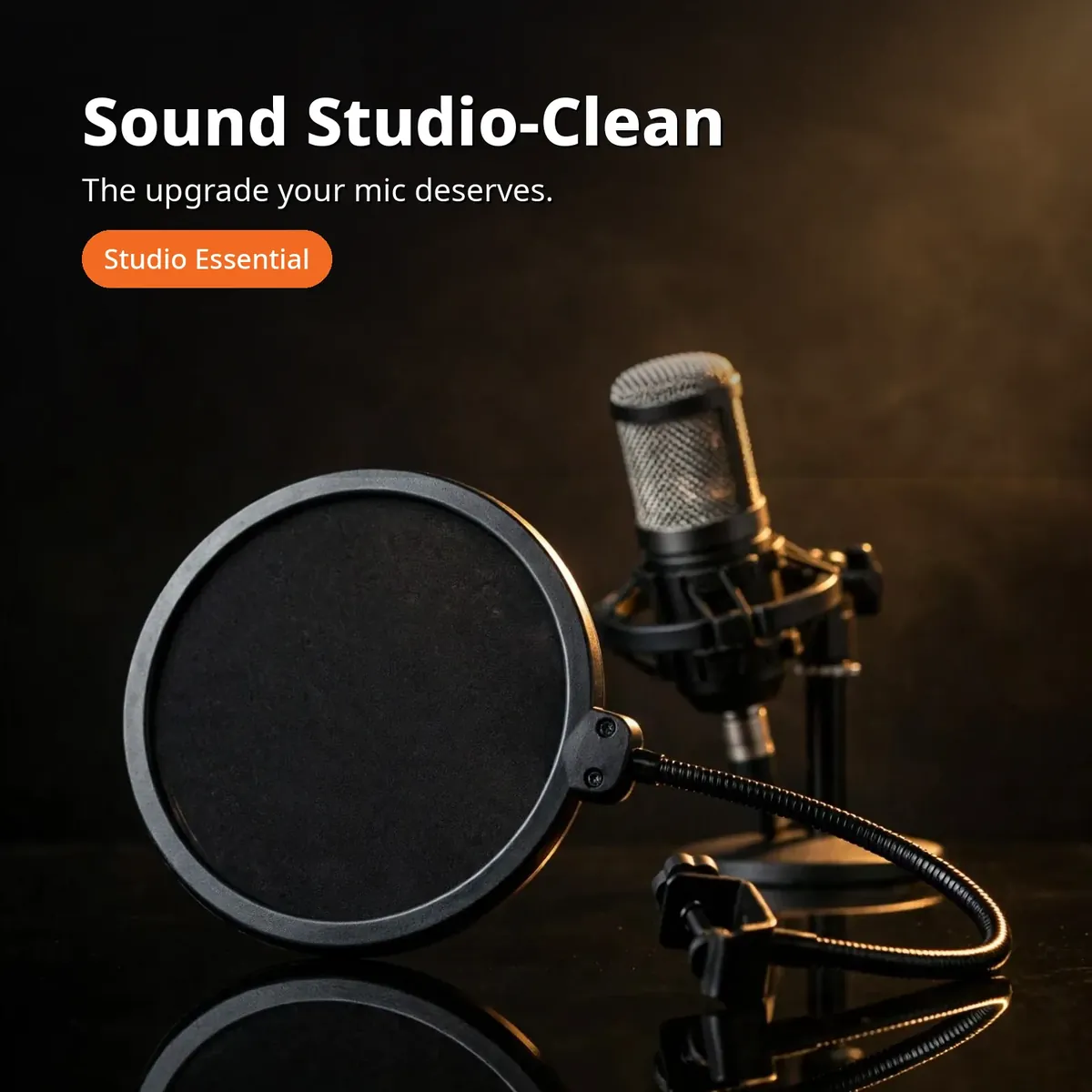
The promo above is the wind pop filter in one glance: the filter on its arm against a premium dark backdrop — “SOUND STUDIO-CLEAN,” with the subline “The upgrade your mic deserves.” and the “Studio Essential” chip. No prices on the card, no fine print games.
Studio-clean is a claim about the recording, not the gear: plosives gone, hissing tamed, voice intact. This filter does not make your mic better — it stops your mic from recording the air blasts it was never meant to capture.
Podcast-Ready Voice
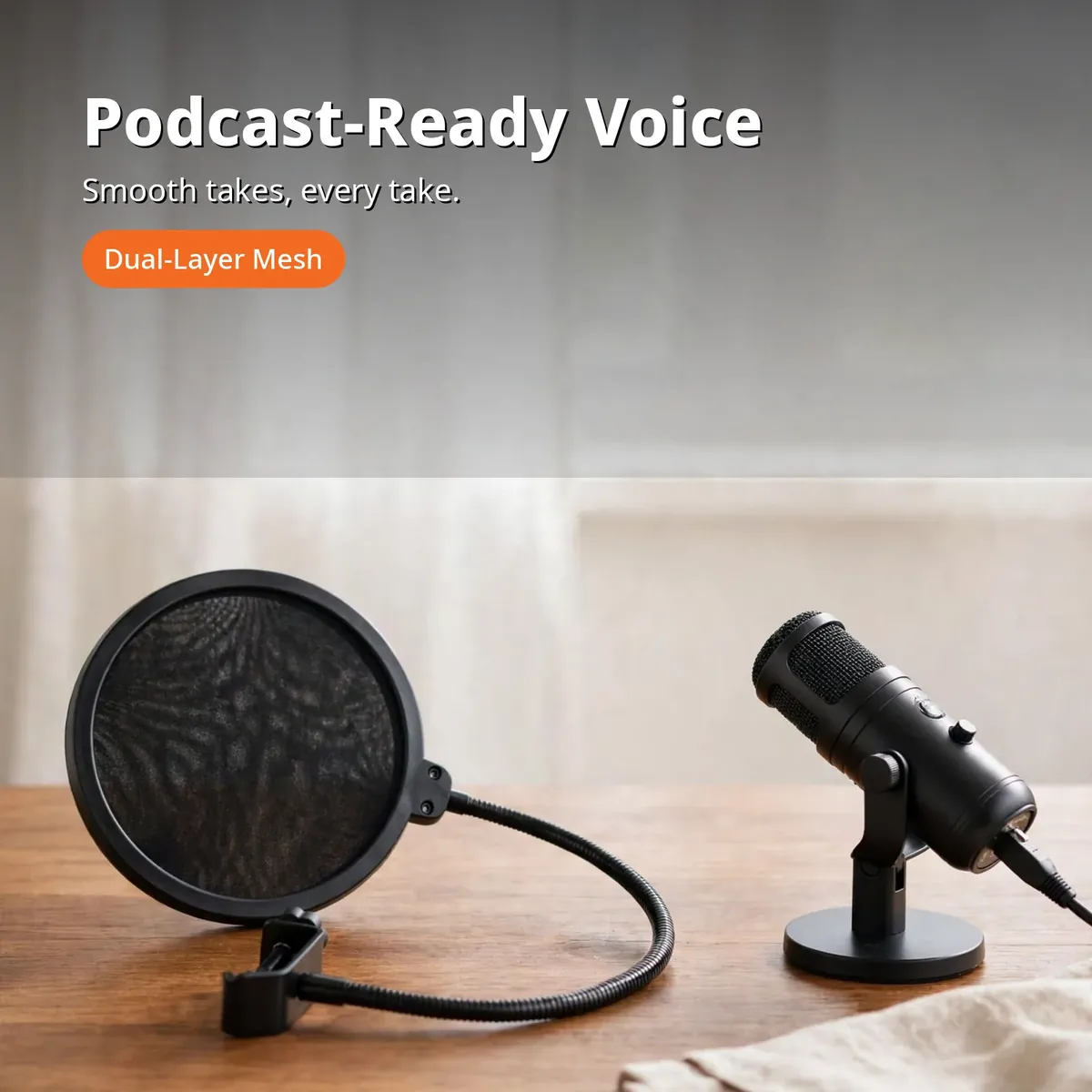
The final promo is the use-case argument: “PODCAST-READY VOICE,” with the subline “Smooth takes, every take.” and the “Dual-Layer Mesh” chip. The wind pop filter lives on podcast desks, voiceover setups, and streaming rigs — anywhere a voice is the product.
Smooth takes, every take is the promise of consistency: the first episode sounds like the fiftieth because the plosives never made it in. For podcasters and streamers, this is the cheapest reliability they can buy.
Dual-Layer Mesh, Up Close
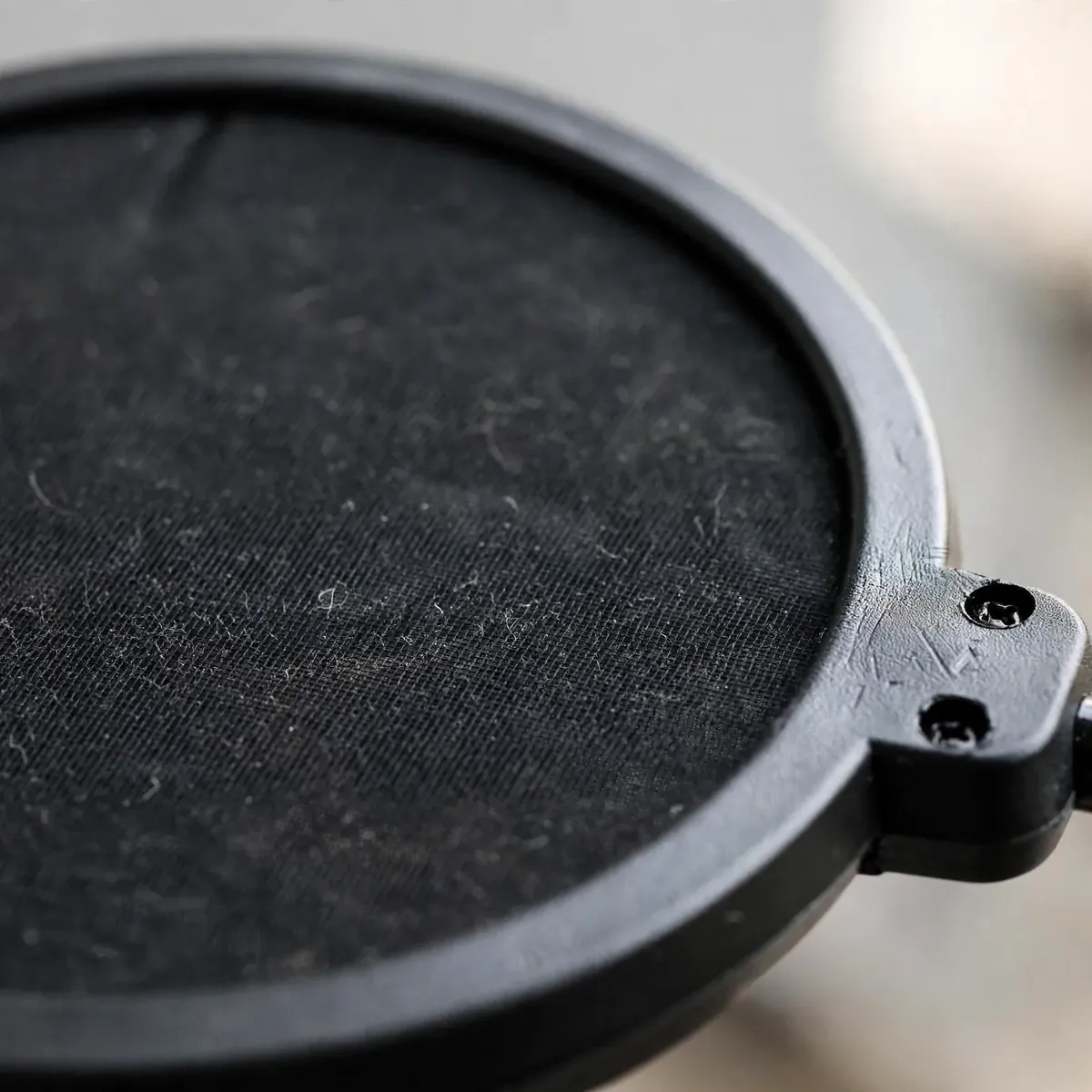
The final shot is the material itself: the wind pop filter’s dual-layer mesh in macro — the fine screen that breaks the air blast while letting voice through. Black, circular, 15.5cm across, in a round frame on the gooseneck.
It also protects your mic: the screen catches spit and moisture from enthusiastic takes, keeping your microphone cleaner for longer. It pays for itself in mic hygiene alone — the plosive killing is the headline.
Specifications
| Brand | No brand — sold as the wind pop filter |
|---|---|
| Model | Wind pop filter — dual-layer mesh microphone pop filter with adjustable arm |
| Type | Microphone accessory (pop filter) — upgrades the mic you already own; not a microphone |
| Screen | Dual-layer mesh; 15.5cm external / 13.5cm internal diameter; tames plosives, hissing, and lisping |
| Arm | 37.5cm flexible gooseneck — bends to any angle, holds position |
| Clamp | Adjustable screw clamp — fits mic stands up to 3.5cm thick (desk arms, tripods, floor stands) |
| Compatibility | Universal fit — works with studio condensers, USB mics (Blue Yeti, Boya, Rode and similar), desk and stand mics |
| Material & weight | Black; plastic arm; 278g |
| Warranty | Covered by a 7-day store warranty. |
All figures are taken from the verified research notes for the wind pop filter — the 15.5cm external / 13.5cm internal screen, 37.5cm gooseneck, 3.5cm clamp fit, and 278g weight are the store page’s own figures. The compatible-mic examples (Blue Yeti, Boya, Rode and similar) are the page’s own examples. This is an accessory: it is never described as a microphone anywhere on this page. No brand is assigned to this product anywhere on this page. Nothing else in this table or on this page is invented.
Why Buy From Gadget Superb
Order the wind pop filter from Gadget Superb with cash on delivery anywhere in Bangladesh — pay in cash when the parcel arrives, with no advance payment, card details, or OTPs ever asked. Delivery takes 1–3 working days inside Dhaka (৳70) and 2–5 working days outside Dhaka (৳120). Every order carries 7-day easy returns: keep the filter in original condition with its packaging, and start a return with your order number via hotline 09638054751, care@gadgetsuperb.com, or Messenger.
Explore the full Audio Electronics collection or compare Microphones to find the right fit.
Frequently Asked Questions
What does a pop filter actually do?
The wind pop filter sits between your mouth and the mic and breaks up the blast of air behind plosives — the P, B, T, K bursts that clip and distort recordings — plus hissing and lisping. Your voice passes through the dual-layer mesh naturally; only the air blasts get stopped. If your voiceovers pop, this filter is the fix, not a new microphone.
Will it fit my microphone?
The wind pop filter is a universal accessory: the adjustable screw clamp grips any mic stand up to 3.5cm thick — desk arms, tripods, and floor stands. It works with studio condensers, USB mics (Blue Yeti, Boya, Rode and similar), desk mics, and stand mics. It clamps to the stand, not the mic, so the mic model barely matters.
Does it change how my voice sounds?
No — that is the design. The wind pop filter’s dual-layer mesh is engineered to stop air, not sound: it kills plosives while your voice passes through with its natural tone intact. Foam windscreens can muffle; this screen does not. The result is recordings that need less cleanup in editing.
How do I position it?
Bend the 37.5cm flexible gooseneck so the 15.5cm screen sits between your mouth and the mic — a few inches from the mic is the classic spot — and it holds position through long sessions. Set it once and forget it. The generous screen covers your whole mouth zone, so you can move naturally while you talk or sing.
What are the exact sizes?
Screen: 15.5cm external / 13.5cm internal diameter. Arm: 37.5cm flexible gooseneck. Clamp: fits stands up to 3.5cm thick. Weight: 278g. All figures are the store page’s own, stated exactly as verified.
Does it protect my microphone?
Yes — the wind pop filter’s screen catches spit and moisture from enthusiastic takes, keeping your microphone cleaner for longer. Mic hygiene is the quiet second job of every pop filter.
Is this a microphone?
No — the wind pop filter is a microphone accessory. It upgrades the mic you already own by removing plosives and protecting the capsule; it does not record anything itself. This page never describes it as a microphone.
Can I use it for singing?
Yes — singers are core users. The wind pop filter tames the P/B/T/K bursts in sung vocals just as it does in speech, and the 15.5cm screen gives you room to move while performing.
Which brand makes the wind pop filter?
No brand is assigned to this product — it is sold simply as the wind pop filter, and this page never invents a brand for it. That is also why this listing carries no external brand link: there is no official brand site to point to.
Who is the wind pop filter for?
Podcasters, voiceover artists, streamers, and singers recording at home — anyone whose voice is the product. If your recordings have harsh pops on P’s and B’s, the wind pop filter remains the cheapest studio-sounding upgrade you can buy.
What warranty does the wind pop filter come with?
The wind pop filter comes with a 7-day store warranty. If you have questions about the warranty terms, contact the store — hotline 09638054751, care@gadgetsuperb.com, or Messenger — before placing your order.
What is the price of the wind pop filter in Bangladesh?
The current price is shown on the product page and can change during sales, so no figure is quoted here. Check the live wind pop filter page on Gadget Superb for today’s price — that is what you pay in cash on delivery, plus the standard delivery fee.
Related products
-28%
29 in stock

FIFINE AMPLIGAME A6T Gaming PC USB Microphone & Podcast Condenser Mic with Boom Arm Microphone
Original price was: ৳ 8,340.৳ 6,000Current price is: ৳ 6,000.-23%
40 in stock

BOYA M1 Microphone (BOYA Official Product)
Original price was: ৳ 1,300.৳ 1,000Current price is: ৳ 1,000.-23%
50 in stock


Hoco L21 ENC Wireless Microphone For Android
Original price was: ৳ 1,300.৳ 1,000Current price is: ৳ 1,000.-28%
48 in stock

MAONO PD100X RGB USB/XLR Dynamic Microphone
Original price was: ৳ 8,890.৳ 6,390Current price is: ৳ 6,390.-28%
18 in stock

Fifine Ampligame AM8 RGB USB/XLR Dynamic Microphone
Original price was: ৳ 9,920.৳ 7,130Current price is: ৳ 7,130. Wind Pop Filter For Microphone...
Original price was: ৳ 520.৳ 410Current price is: ৳ 410.
173 in stock
Reviews
There are no reviews yet.